
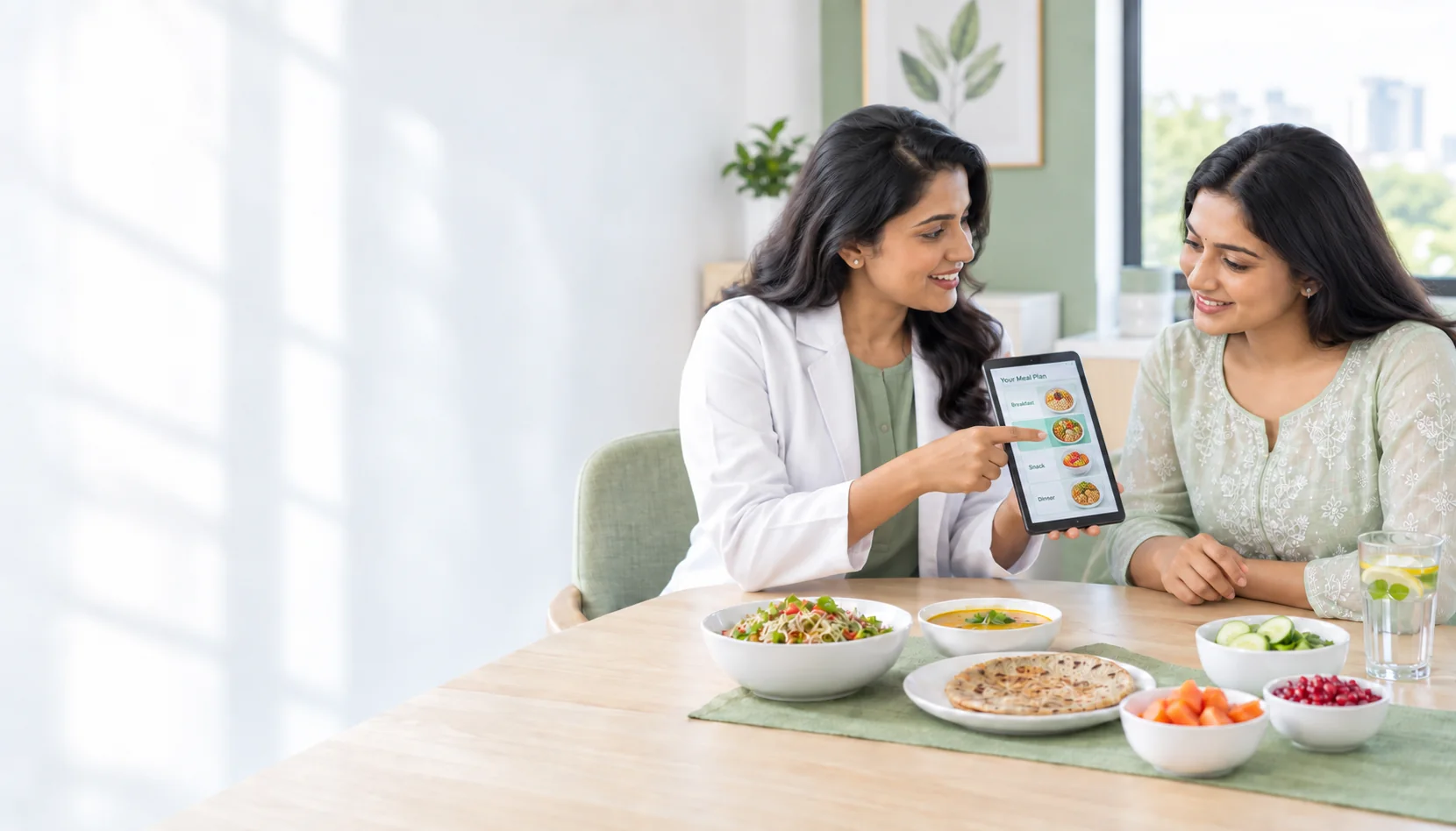
If your BMI is 30 or above, your breakfast should give you about 350 to 450 calories and 20 to 30 grams of protein.
Most Indian breakfasts give the calories but not the protein. That one gap is why you feel hungry again by eleven o'clock.
Not sure of your number? Check your BMI here. It takes one minute.
What your usual breakfast actually gives you
Here are the real numbers for common plates.
Four idlis with sambar and chutney: about 420 calories and only 9 g protein.
Two dosas with chutney: about 400 calories and 7 g protein.
One cup of upma: about 270 calories and 5 g protein.
Two pooris with potato curry: about 420 calories and 7 g protein.
Chai with sugar and two biscuits: about 230 calories and 3 g protein.
See the pattern. The calories are fine. The protein is less than half of what you need.
Why low protein makes you hungry at eleven
Carbohydrate digests fast. Protein does not. A plate that is almost all rice or flour is finished inside two hours, so your blood sugar rises and then drops.
That drop is what you feel as real hunger at eleven. At BMI 30 and above the drop is sharper, because the body handles sugar less well at this weight. So you reach for a biscuit, a samosa or another sweet chai.
You did not lose control at eleven. Your breakfast was wrong at eight.
Three simple breakfasts with their numbers
Two idlis, dal-rich sambar, one bowl of curd: about 330 calories and 15 g protein.
Two boiled eggs, one slice of whole wheat toast, one glass of milk: about 350 calories and 22 g protein.
One pesarattu with one egg and a bowl of curd: about 390 calories and 20 g protein.
All three cost less than a restaurant breakfast and take under ten minutes.
Easy protein you already have at home
One boiled egg gives 6 g protein for 75 calories.
One bowl of curd gives 7 g protein for about 120 calories.
One glass of milk gives 6 g protein for about 120 calories.
One cup of sprouted moong gives 8 g protein for about 110 calories.
A handful of roasted chana gives 6 g protein for about 110 calories.
Add any two of these to your usual tiffin and the morning is fixed.
Three changes that save calories without giving anything up
Take half the chutney and more sambar. Two spoons of coconut chutney is about 90 calories and almost no protein. The same amount of sambar has dal in it.
Drop the sugar in your tea. Two spoons is 40 calories a cup. Four cups a day is 160 calories, every day, that nobody counts.
Eat the curd, dal and vegetables first and the rice or dosa last. Same food, smaller sugar rise.
When breakfast is a medical question
At BMI 30 and above, thyroid problems, pre-diabetes, diabetes, fatty liver and PCOD are all common, and often there are no symptoms. Each of them changes what your breakfast should be, and none can be guessed from a plate.
A LIFE dietician reads your reports, your routine and the food your family actually cooks, and writes a plan around that.
₹999 diet consultation: 30 to 45 minutes, online or at any of our 11 branches, a written plan within 48 hours and one review call.
Common questions
How many calories should breakfast have for weight loss at BMI 30
About 350 to 450 calories, with 20 to 30 grams of protein. The protein matters more than the calorie figure, because it is what keeps you full until lunch.
Is idli good for weight loss
Yes, in the right number and with the right partners. Two idlis with dal-rich sambar and a bowl of curd is about 330 calories with 15 g protein. Four idlis with thin sambar and chutney is 420 calories with 9 g protein, and you will be hungry by eleven.
Should I skip breakfast to lose weight at BMI 30
Usually no. At this weight skipping breakfast nearly always leads to a bigger lunch and uncontrolled eating at night. Eating protein in the morning is what makes the evening manageable.
How much protein do I need in a day at BMI 30
Most adults at this weight need roughly 1 to 1.2 grams per kilogram of a healthy target weight, which for many people is 60 to 80 grams a day. Your dietician will set the exact figure from your reports.